
Hyundai Elantra: Brake System / Brake Pedal Repair procedures
| Removal |
| 1. |
Turn ignition switch OFF and disconnect the negative (-) battery cable. |
| 2. |
Remove the crash pad lower panel.
(Refer to Body - "Crash Pad") |
| 3. |
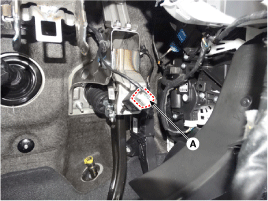
Disconnect the stop lamp switch connector (A).
|
| 4. |
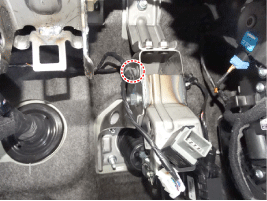
Remove the wiring fixed clip from the brake pedal member.
|
| 5. |
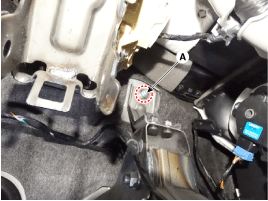
Remove the bracket mounting nut (A).
|
| 6. |
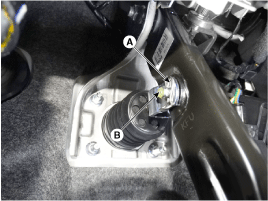
Remove the snap pin (A) and clevis pin (B).
|
| 7. |
Remove the mounting nuts (A).
|
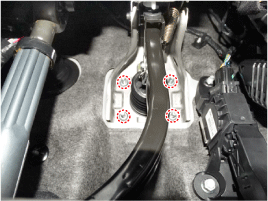
| 8. |
To install, reverse the removal procedure. |
| Inspection |
| 1. |
Check the brake pedal for bending or twisting. |
| 2. |
Check the brake pedal return spring for damage. |
| 3. |
Check the stop lamp switch. |
 Brake Pedal Components and Components Location
Components
1. Stop lamp switch2. Brake pedal member assembly3. Return spring4. Bolt5. Brake pedal arm assembly
...
 Front Disc Brake Components and Components Location
Components
1. Caliper body2. Bleed screw3. Pad return spring4. Brake pad5. Caliper carrier6. Pad inner shim7. Pad retainer
...
Other information:
Hyundai Elantra AD (2016-2020) Owners Manual: System Operation
Ventilation
1. Select the Face Level mode.
2. Set the air intake control to the outside (fresh) air position.
3. Set the temperature control to the desired position.
4. Set the fan speed control to the desired speed.
Heating
1. Select the Floor Level mode.
2. Set the air intake control to t ...
Hyundai Elantra AD (2016-2020) Service Manual: Battery Sensor Description and Operation
Description
Vehicles have many control units that use more electricity.
These units control their own system based on information from diverse
sensors. It is important to have a stable power supply as there diverse
sensors giving a variety of information. Battery sensor is mounted on
ba ...
