
Hyundai Elantra: Charging System / Alternator Repair procedures
| Removal |
| 1. |
Turn ignition switch OFF and disconnect the negative (-) battery cable. |
| 2. |
Remove the drive belt.
(Refer to Engine Mechanical System - "Drive Belt") |
| 3. |
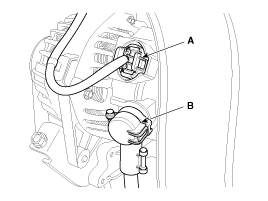
Disconnect the alternator connector (A) and the cable (B) from alternator "B" terminal.
|
| 4. |
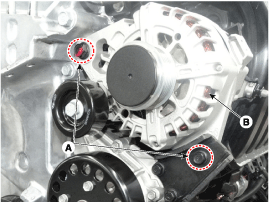
Remove the alternator (B) after loosening the mounting bolts (A).
|
| Installation |
| 1. |
Install in the reverse order of removal. |
| 2. |
Adjust the alternator belt tension after installation.
(Refer to Engine Mechanical System - "Drive Belt")
|
 Alternator Schematic Diagrams
Circuit Diagram
•
COM signal - When
controlling the voltage generated, the ECM sends the target voltage data
to the alternator via a PWM signal.(High voltage: 4V or h ...
 Battery Description and Operation
Description
[AGM Battery]
AGM battery is used for especially heavy load on the vehicle
network depending on equipment and requirements. AGM stands for
Absorbent Glass Material Battery; that is ...
Other information:
Hyundai Elantra AD (2016-2020) Service Manual: Parking Brake Switch Repair procedures
Removal
1.
Disconnect the negative (-) battery cable.
2.
Release the parking brake.
3.
Remove the floor console assembly.
(Refer to Body - "Floor console")
4.
Disconnect the connector (A) of parking brake switch.
5.
Loosen the screw and then remove the parking brake switch.
...
Hyundai Elantra AD (2016-2020) Service Manual: Rear Oil Seal Repair procedures
Removal
1.
Remove the automatic transaxle.
(Refer to Automatic Transaxle System - "Automatic Transaxle")
2.
Remove the drive plate.
(Refer to Cylinder Block – “Drive Plate�)
3.
Remove the rear oil seal (A).
Installation
1.
Install a new rear oil seal.
(1)
Apply engine oil ...
