
Hyundai Elantra: Engine Control System / Purge Control Solenoid Valve (PCSV) Repair procedures
Hyundai Elantra AD (2016-2020) Service Manual / Engine Control/Fuel System / Engine Control System / Purge Control Solenoid Valve (PCSV) Repair procedures
| Inspection |
| 1. |
Turn the ignition switch OFF. |
| 2. |
Disconnect the PCSV connector. |
| 3. |
Measure resistance between the PCSV terminals 1 and 2. |
| 4. |
Check that the resistance is within the specification.
|
| Removal |
| 1. |
Turn the ignition switch OFF and disconnect the battery negative (-) cable. |
| 2. |
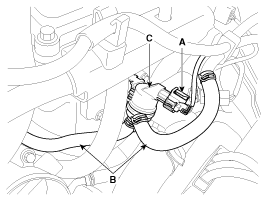
Disconnect the purge control solenoid valve connector (A). |
| 3. |
Disconnect the vapor hoses (B) from the purge control solenoid valve. |
| 4. |
Remove the valve (C) from the surge tank after pulling it.
|
| Installation |
|

|
| 1. |
Installation is reverse of removal.
|
 Purge Control Solenoid Valve (PCSV) Schematic Diagrams
Circuit Diagram
...
 CVVT Oil Control Valve (OCV) Description and Operation
Description
Continuous Variable Valve Timing (CVVT) system advances or
retards the valve timing of the intake and exhaust valve in accordance
with the ECM control signal which is calculated by ...
Other information:
Hyundai Elantra AD (2016-2020) Service Manual: Electric Thermostat (ECT) Description and Operation
Description and Operation
Electric Thermostat (ECT)
Overview
Optimal control of coolant temperature depending on the driving conditions
Operation Principle
Electric Thermostat Structure
...
Hyundai Elantra AD (2016-2020) Service Manual: Automatic Transaxle Repair procedures
Removal
1.
Remove the engine cover.
(Refer to Engine Mechanical System - "Engine cover")
2.
Remove the air cleaner assembly and air duct.
(Refer to Engine Mechanical System - "Air cleaner")
3.
Remove the battery and battery tray.
(Refer to Engine Electrical System - "Battery")
4 ...
© 2018-2026 www.helantraad.com
