
Hyundai Elantra: Engine Control System / Engine Coolant Temperature Sensor (ECTS) Description and Operation
| Description |
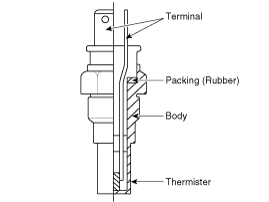
 Intake Air Temperature Sensor (IATS) Repair procedures
Inspection
1.
Turn the ignition switch OFF.
2.
Disconnect the IATS connector.
3.
Measure resistance between the IATS terminals 3 and 4.
4.
Check that the resistance is within the speci ...
 Engine Coolant Temperature Sensor (ECTS) Specifications
Specification
TemperatureResistance (k?)°C°F-40-4048.14-20-414.13 ~ 16.830325.7920682.31 ~ 2.59401041.15601400.59801760.32
...
Other information:
Hyundai Elantra AD (2016-2020) Service Manual: Troubleshooting
Trouble Symptom Charts
Trouble Symptom 1
Trouble Symptom 2
Trouble symptomProbable causeRemedyThe set vehicle speed varies greatly upward or downward"Surging" (repeated alternating acceleration and deceleration) occurs after settingMalfunction of the vehicle speed sensor circuitRepair the veh ...
Hyundai Elantra AD (2016-2020) Service Manual: Head Lamps Description and Operation
HID Head Lamp
1.
Bulb
(1)
Elements
Xenon gas : Xenon gas activates the initial reaction for rapid illuminating.
Molybdenum electrode: anode arcing
Metal halide salts : color composing component
(2)
Lightening principle
When Xenon gas and metal halide salt will discharge the molybdenum ...
