
Hyundai Elantra: Tires and Wheels / Tire Rotation
To equalize tread wear, HYUNDAI recommends that the tires be rotated every 7,500 miles (12,000 km) or sooner if irregular wear develops.
During rotation, check the tires for correct balance.
When rotating tires, check for uneven wear and damage. Abnormal wear is usually caused by incorrect tire pressure, improper wheel alignment, outof- balance wheels, severe braking or severe cornering. Look for bumps or bulges in the tread or side of tire. Replace the tire if you find either of these conditions. Replace the tire if fabric or cord is visible. After rotation, be sure to bring the front and rear tire pressures to specification and check lug nut tightness (proper torque is 79~94 lbf·ft [11~13 kgf·m]).
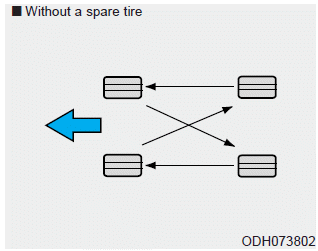
Disc brake pads should be inspected for wear whenever tires are rotated.
Information
Tires that are asymmetrical or directional can only be installed on the wheel in one direction. The outside and inside of an asymmetrical tire is not easily distinguishable. Pay careful attention to the markings on the sidewalls of the tires, noting the "outside" marking and also the rotating direction before installing them on the vehicle.
WARNING
- Do not use the compact spare tire for tire rotation.
- Do not mix bias ply and radial ply tires under any circumstances. This may cause unusual handling characteristics that may cause loss of vehicle control resulting in an accident.
 Check Tire Inflation Pressure
Check your tires, including the spare tire, once a month or more.
How to check
Use a good quality tire pressure gauge to check tire pressure. You can not tell
if your tires are properly inflated s ...
 Wheel Alignment and Tire Balance
The wheels on your vehicle were aligned and balanced carefully at the factory
to give you the longest tire life and best overall performance.
In most cases, you will not need to have your wheels al ...
Other information:
Hyundai Elantra AD (2016-2020) Service Manual: Front Seat Assembly Repair procedures
Replacement
1.
Open the cover and loosen the front seat mounting bolts.
[Front]
Tightening torque :
49.0 ~ 63.7 N.m (5.0 ~ 6.5 kgf.m, 36.2~ 47.0 lb-ft)
[Rear]
Tightening torque :
49.0 ~ 63.7 N.m (5.0 ~ 6.5 kgf.m, 36.2 ~ 47.0 lb-ft)
2.
Disconnect the main connector (A), front ...
Hyundai Elantra AD (2016-2020) Service Manual: Intake Actuator Specifications
Specifications
Door positionVoltage (V)Error detectingMax. cooling0.3 ± 0.15 Low voltage : 0.1V or lessMax. heating4.7 ± 0.15 High voltage : 4.9V or more
...
