
Hyundai Elantra: With Tire Mobility Kit (TMK, if equipped) - Type B / Components of the Tire Mobility Kit
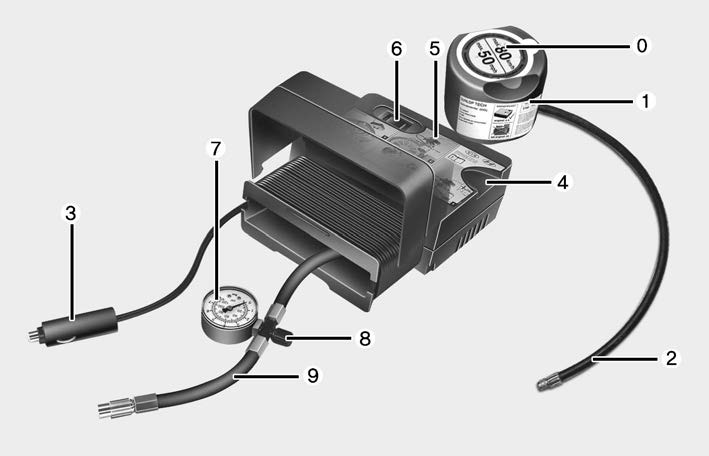
0. Speed restriction label
1. Sealant bottle and label with speed restriction
2. Filling hose from sealant bottle to wheel
3. Connectors and cable for power outlet direct connection
4. Holder for the sealant bottle
5. Compressor
6. ON/OFF switch
7. Pressure gage for displaying the tire inflation pressure
8. Screw cap for reducing tire inflation pressure
9. Hose to connect compressor and sealant bottle or compressor and wheel
Connectors, cable and connection hose are stored in the compressor housing.
Strictly follow the specified sequence, otherwise the sealant may escape under high pressure.
WARNING
Do not use the tire sealant after the sealant has expired (i.e. pasted the expiration date on the sealant container). This can increase the risk of tire failure.
WARNING
- Keep out of reach of children.
- Avoid contact with eyes.
- Do not swallow.
 Notes on the safe use of the Tire Mobility Kit
Park your car at the side of the road so that you can work with the Tire
Mobility Kit away from moving traffic.
To be sure your vehicle will not move, even when you’re on fairly level
gro ...
 Using the Tire Mobility Kit
1. Detach the speed restriction label (0) from the sealant bottle (1), and place
it in a highly visible place inside the vehicle such as on the steering wheel to
remind the driver not to drive too ...
Other information:
Hyundai Elantra AD (2016-2020) Owners Manual: Heating and Air Conditioning
1. Start the engine.
2. Set the mode to the desired position. To improve the effectiveness of heating
and cooling : - Heating: - Cooling:
3. Set the temperature control to the desired position.
4. Set the air intake control to the outside (fresh) air or recirculated air
position.
5. Set t ...
Hyundai Elantra AD (2016-2020) Service Manual: Auto Defoging Actuator Repair procedures
Inspection
1.
Turn the ignition switch OFF.
2.
Disconnect the auto defogging connector.
3.
Verify that the auto defogging actuator operates to the open
position when connecting 12V to terminal 3 and grounding terminal 4.
Verify that the auto defogging actuator operates to the close ...
